

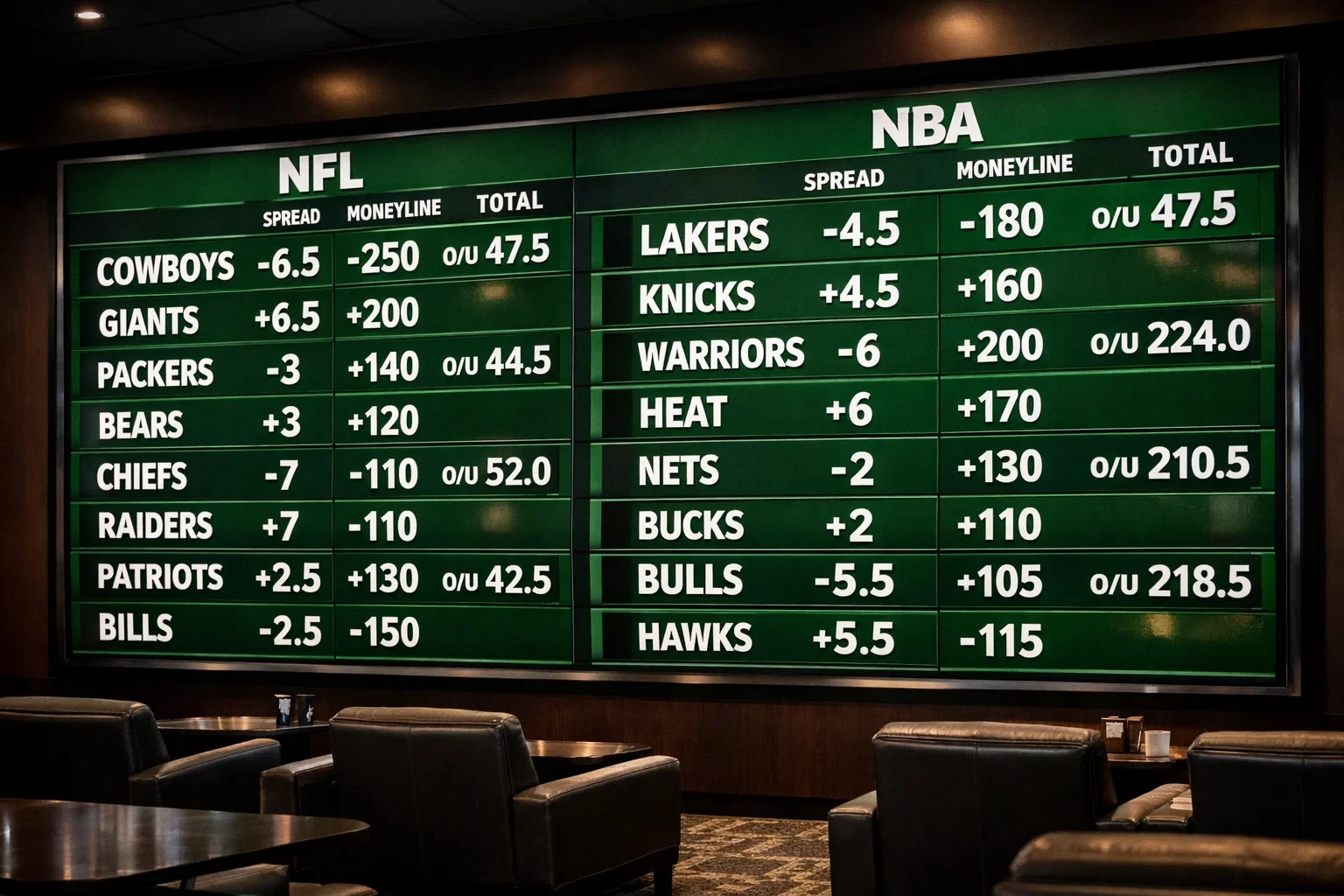
The three foundational bet types – point spreads, moneylines, and totals – constitute the overwhelming majority of sports betting action. Every other wager type builds upon or derives from these core concepts. Understanding them thoroughly enables intelligent participation in sports betting; misunderstanding them guarantees confusion and poor decisions. This guide explains each bet type with the mathematical precision necessary for calculating payouts while providing the strategic context that transforms mechanical understanding into practical betting knowledge.
These bet types exist because they solve specific problems for sportsbooks and bettors alike. Point spreads equalize lopsided matchups. Moneylines provide straightforward win-outcome betting. Totals offer betting opportunities independent of game winners. Each serves distinct purposes and suits different betting scenarios. Knowing when to use each type – not just how they work mechanically – represents the knowledge gap separating recreational bettors from those who approach wagering with more sophistication.
Point Spreads Decoded
Point spreads represent the sportsbook’s predicted margin of victory, transformed into a betting market where both sides offer roughly equal value. When the Bills are -6.5 against the Jets, the sportsbook expects Buffalo to win by approximately 7 points. Setting the spread at 6.5 creates a betting proposition where taking Buffalo requires them to win by 7 or more, while taking New York means they can lose by 6 or fewer (or win outright) for bettors to collect.
The half-point eliminates ties (“pushes”) that would result in returned stakes. A spread of -6.5 means the favorite must win by at least 7 for spread bettors to win; exactly 6 wouldn’t cover because 6 is not greater than 6.5. Spreads can be whole numbers (-7, -3, +10) which create push possibilities when the margin exactly equals the spread. On a push, bets are returned with no win or loss recorded – essentially a void outcome.
Standard spread pricing shows -110 on both sides, meaning you risk $110 to win $100 regardless of which team you back. This symmetry exists because the spread itself theoretically equalizes the matchup, making each side approximately a 50/50 proposition. The $10 difference between risked amount ($110) and potential win ($100) represents the sportsbook’s commission. Some sportsbooks occasionally offer -105 or -108 on spreads as promotional pricing, representing meaningfully better value than the -110 standard.
Spread movement reveals betting market sentiment. If the Bills open at -6.5 and move to -7.5 by game time, heavy action on Buffalo prompted the adjustment. Sportsbooks move lines to balance their exposure and reduce risk from lopsided action. Sophisticated bettors track line movement to understand where money flows and sometimes fade public consensus. Recreational bettors typically don’t benefit from this analysis, but understanding that spreads move and why helps contextualize the numbers you see.
Calculating spread bet payouts uses standard American odds conversion. At -110, multiply your stake by 100/110 (or equivalently, divide by 1.1) to find your profit on a winning bet. A $55 bet at -110 returns $55 plus $50 profit ($105 total). A $220 bet returns $220 plus $200 profit ($420 total). The formula works regardless of stake size: Profit = Stake x (100 / |Odds|) for negative odds.
Moneyline Mechanics
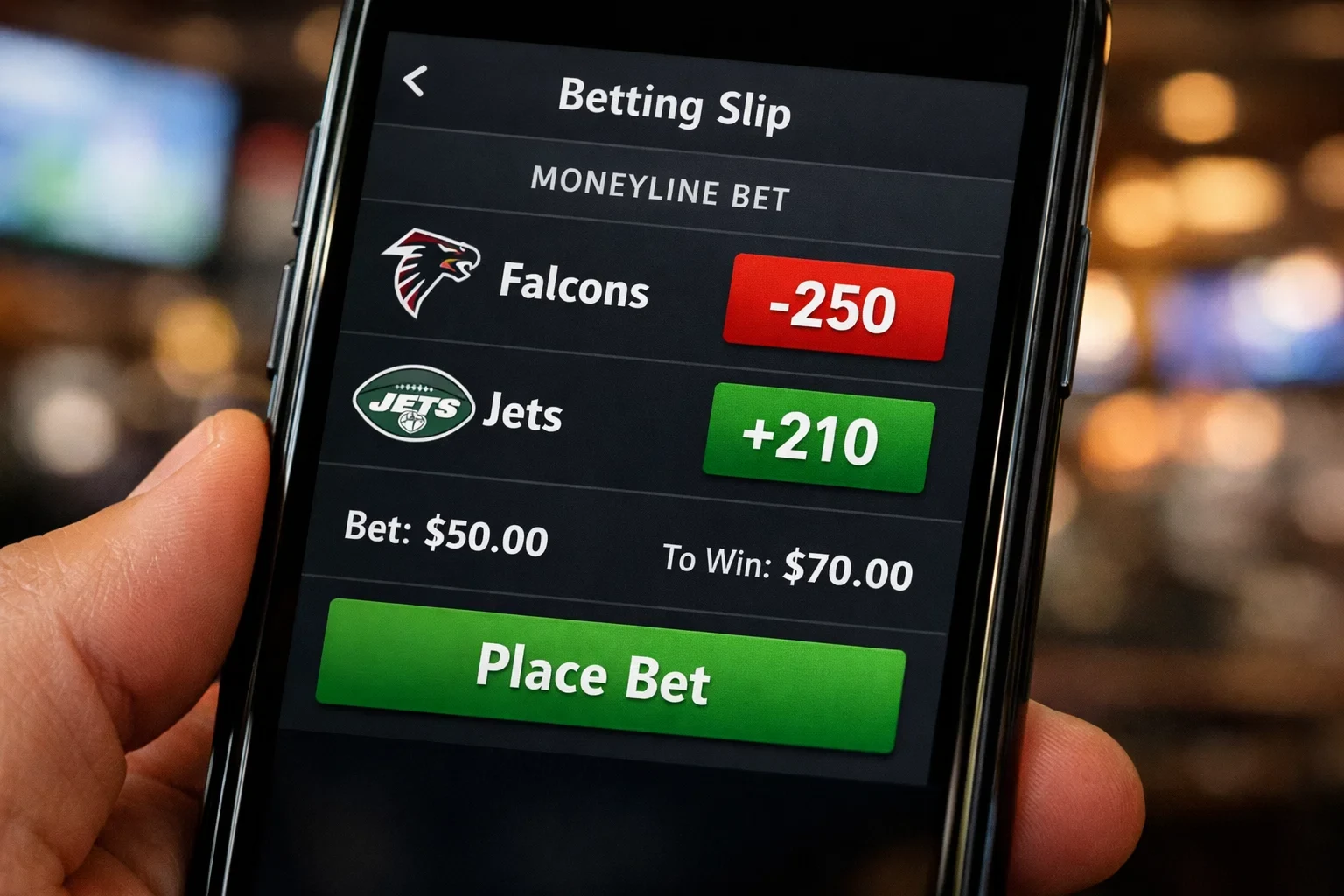
Moneylines strip away margin-of-victory complexity – you’re betting on which team wins, period. A one-point victory and a 30-point blowout produce identical results for moneyline bettors. This simplicity appeals to bettors confident in picking winners without conviction about margins. The tradeoff involves odds that vary dramatically based on perceived winning probability rather than the standardized -110 pricing of spread bets.
Favorites show negative moneylines indicating your risk-to-win-$100 requirement. The Chiefs at -250 means betting $250 to win $100 profit. Heavy favorites like -500 or -800 require substantial risk for modest returns – $800 risked for $100 potential profit feels disproportionate for most recreational bettors. These prices reflect high implied probability; -250 suggests approximately 71% win expectation, while -500 implies about 83% confidence.
Underdogs show positive moneylines indicating potential profit from $100 risked. The Broncos at +210 means $100 wins $210 profit if Denver wins outright. Bigger underdogs show larger positive numbers – +400, +800, or even +2000 for extreme longshots. These prices reflect low implied probability; +210 suggests roughly 32% win expectation, while +400 implies about 20% chance.
Calculating implied probability from moneylines helps assess value. For negative odds: Implied Probability = |Odds| / (|Odds| + 100). So -250 implies 250 / 350 = 71.4% probability. For positive odds: Implied Probability = 100 / (Odds + 100). So +210 implies 100 / 310 = 32.3% probability. These calculations reveal what winning percentage you’d need for the bet to break even – your own probability estimate should exceed this threshold before considering the wager.
Moneyline versus spread decisions depend on specific game analysis. If you believe the Eagles will beat the Cowboys but worry they might win by fewer than the 4.5-point spread, the moneyline provides exposure to the win without margin risk. You’ll pay in odds (maybe -200 versus -110) but eliminate spread-covering uncertainty. Conversely, when spreads seem generous relative to expected margins, spread betting captures better value than paying premium moneyline prices for favorites.
Claim huge casino welcome bonuses.
Totals (Over/Under) Explained
Totals focus betting interest on combined scoring rather than game winners. The sportsbook sets a number representing their expected combined score; bettors wager whether actual scoring will exceed (over) or fall short (under) of that total. A total of 47.5 for an NFL game creates two betting options: over 47.5 wins if teams combine for 48+ points; under 47.5 wins at 47 or fewer points.
Totals appeal to bettors who see high-scoring or defensive games developing without strong conviction about winners. If two prolific offenses meet when both defenses struggle, the over might seem obvious regardless of which team wins. Similarly, weather conditions like heavy rain or strong wind can suppress scoring, making unders attractive independent of spread or moneyline analysis. This independence from game-winner prediction expands betting opportunities.
Half-points on totals serve the same push-prevention function as on spreads. A total of 47.5 cannot result in a push because combined scores can’t be fractional. Whole-number totals (47, 48) create push possibilities when scoring lands exactly on the number. Some bettors pay small odds premiums (“buying points”) to move totals to more favorable numbers, converting push possibilities into wins or losses in their direction.
Standard total pricing mirrors spread pricing at -110 both sides. The same commission structure applies – risk $110 to win $100 regardless of over or under selection. As with spreads, some sportsbooks occasionally offer reduced juice on totals as competitive differentiation. Line shopping for -105 or -108 totals provides meaningful value improvement over -110 standard pricing.
Total movement responds to betting action and information changes. If a total opens at 47.5 and moves to 49.5, heavy over action shifted the line. Late-breaking news like key offensive player injuries might move totals substantially as scoring expectations adjust. Understanding why totals move helps bettors assess whether line changes reflect meaningful information or simply public money flow.
Practical Payout Calculations
Mastering payout calculations enables quick evaluation of betting opportunities without relying on sportsbook bet slip displays. These formulas work across bet types and odds formats.
For negative American odds: Total Payout = Stake + (Stake x 100 / |Odds|). Example: $150 bet at -150 returns $150 + ($150 x 100 / 150) = $150 + $100 = $250 total ($100 profit).
For positive American odds: Total Payout = Stake + (Stake x Odds / 100). Example: $50 bet at +180 returns $50 + ($50 x 180 / 100) = $50 + $90 = $140 total ($90 profit).
Converting to decimal odds simplifies multiplication: Decimal = (100 / |Odds|) + 1 for negatives; Decimal = (Odds / 100) + 1 for positives. So -150 becomes 1.67 decimal; +180 becomes 2.80 decimal. Then simply multiply: $150 x 1.67 = $250 total return; $50 x 2.80 = $140 total return.
Parlay calculations multiply decimal odds across legs. A two-leg parlay combining -110 and +150: Convert to 1.91 and 2.50 decimal. Multiply: 1.91 x 2.50 = 4.775 combined odds. A $100 bet returns $477.50 total ($377.50 profit) if both legs win.
Strategic Considerations
Choosing between bet types depends on your analysis and risk preferences. Spread betting suits situations where you have conviction about margin of victory and find the number fair or favorable. Moneyline betting suits strong winner conviction without margin confidence or when moneyline value exceeds spread value. Total betting suits scoring-focused analysis independent of winner prediction.
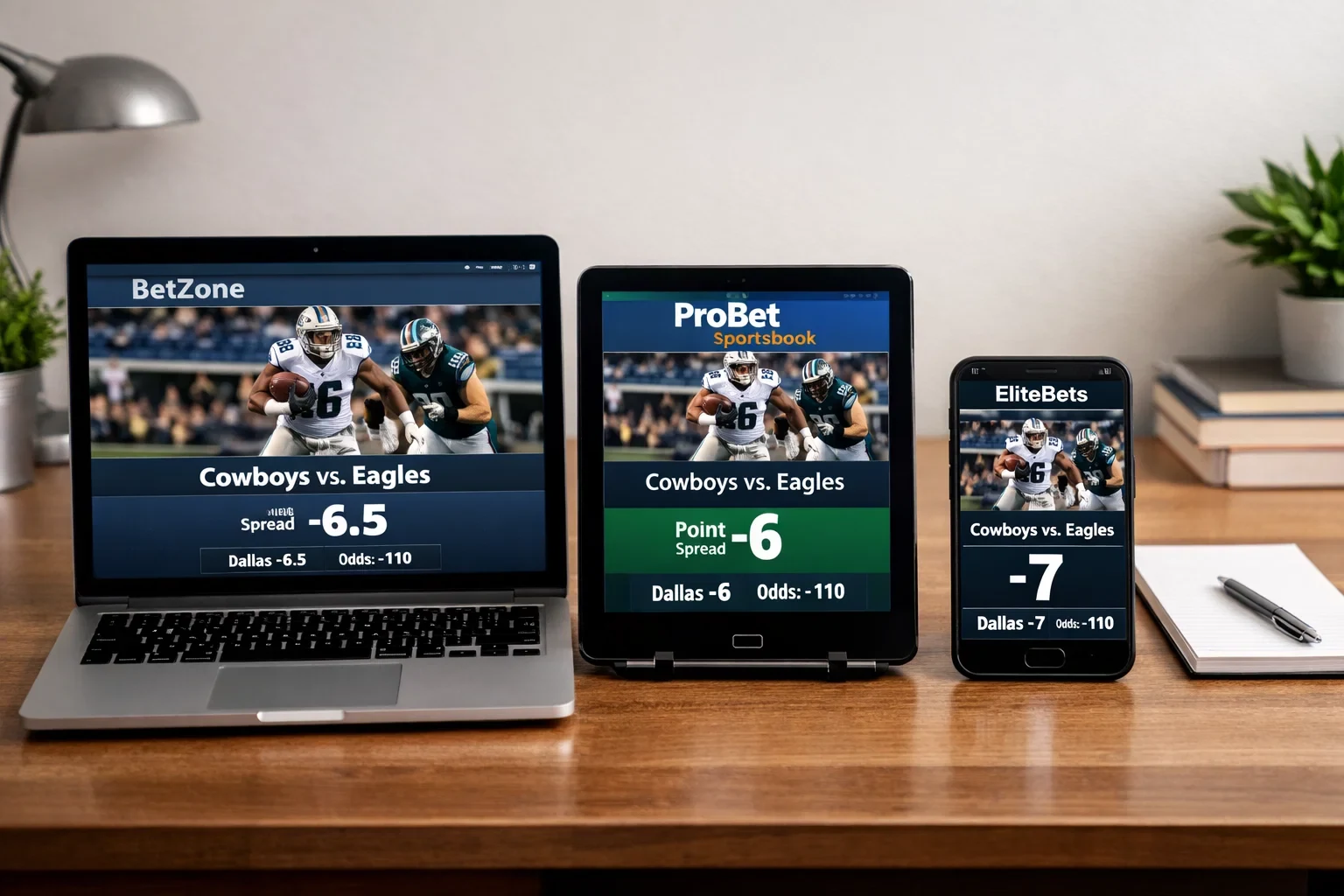
Line shopping across sportsbooks captures meaningful value regardless of bet type. One platform might show -6.5 (-110) while another shows -6 (-115) for identical games. The half-point difference substantially affects win probability – buying from -6.5 to -6 removes push possibility on exactly 6-point margins. Similarly, finding -105 totals versus -110 competitors saves money over time without requiring superior game analysis.
Correlated outcomes between bet types sometimes inform strategy. If you strongly believe a dominant team covers a large spread, the game total might lean over as blowouts typically involve higher scoring. Recognizing these correlations helps identify which bet types offer related value when your game thesis proves correct. However, sportsbooks limit the most obviously correlated bets in same-game parlays for exactly this reason.
The juice differential between bet types rarely justifies choosing inferior strategic fits. Paying -110 on a spread bet you’ve analyzed thoroughly beats paying -110 on a moneyline you’ve barely considered simply because both carry identical juice. Match your bet selection to your analysis rather than searching for the cheapest juice across bet types. The analysis quality matters more than minor pricing differences when your underlying thesis determines outcomes.
Starting bettors should focus on one bet type until comfortable before diversifying. Learning spread betting thoroughly provides foundation for understanding how sportsbooks set lines and how those lines move. Moneylines and totals introduce additional complexity best approached after fundamentals feel solid. This sequential learning prevents the confusion that comes from juggling multiple unfamiliar concepts simultaneously while trying to make betting decisions.
Enjoy stable extra income through top casino sports book.
