

Sports bettors venturing into casino games often approach them with the analytical mindset that serves handicapping well but misapplies to different gaming formats. Casino games operate on fixed mathematical structures where optimal strategies are known and deviation guarantees worse results. Unlike sports betting, where edges exist for skilled bettors to find, casino games offer no exploitable information advantages – only the choice between playing optimally to minimize house edge or playing suboptimally to increase it.
This guide provides the strategic foundation for blackjack, video poker, and intelligent slot selection. These aren’t systems for beating the house; they’re frameworks for reducing the mathematical disadvantage you face. The sports bettor who understands expected value and bankroll management already possesses foundational concepts – applying them to casino contexts simply requires learning game-specific optimal play.
Blackjack Basic Strategy Essentials
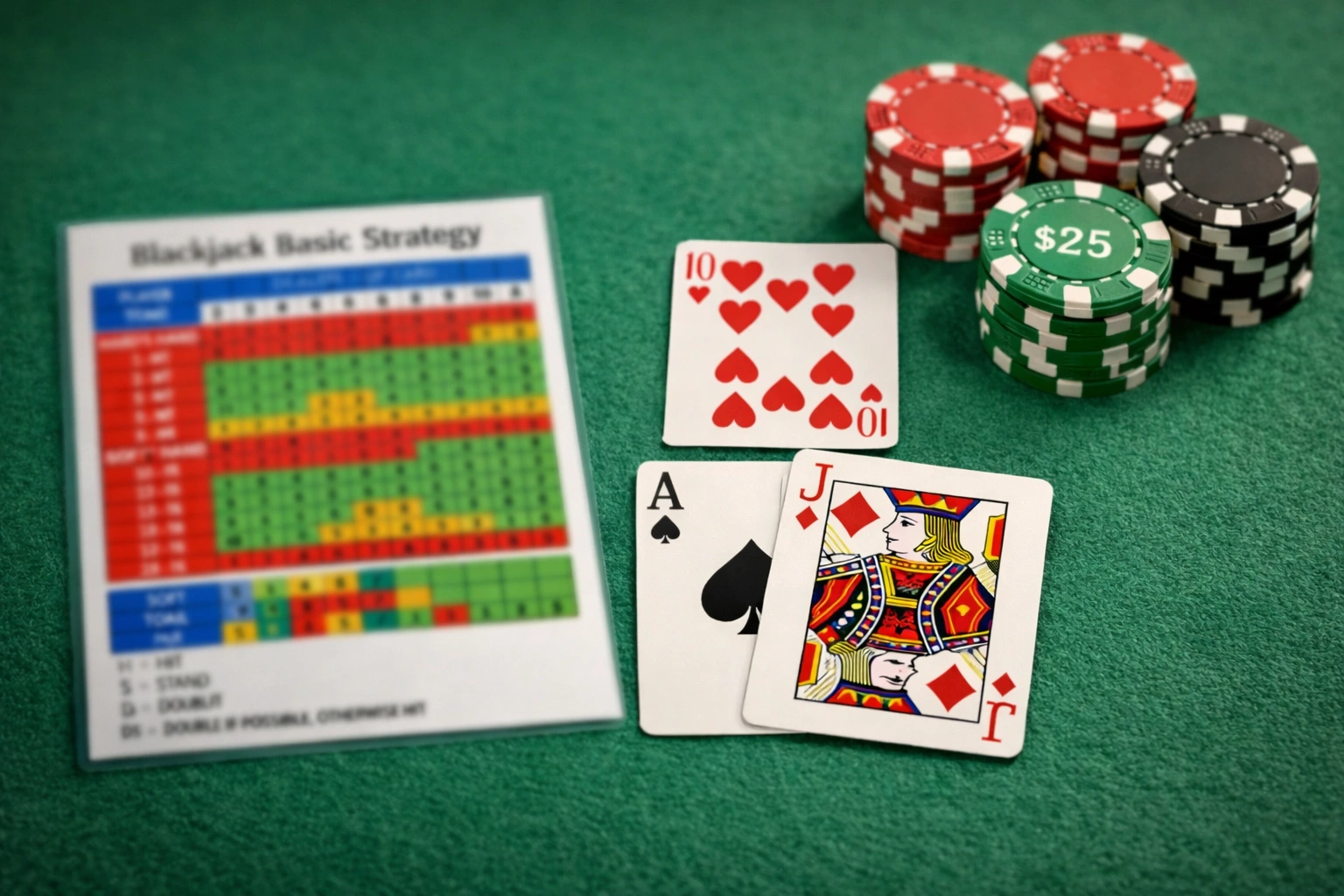
Blackjack stands alone among common casino games in offering house edges below 1% for players who learn basic strategy. The combination of player decisions and fixed dealer rules creates a mathematically solvable game where every situation has an optimal play determined by your cards and the dealer’s up-card. Learning basic strategy transforms blackjack from a guessing game into precision execution.
Basic strategy charts specify the correct action for every possible hand combination. These aren’t opinions or systems – they’re mathematically derived optimal plays that minimize long-term losses. Hit on hard 16 against dealer’s 7-A; stand on hard 16 against 2-6. Double down on 11 against anything except dealer’s A. Split 8s always; never split 10s. Hundreds of specific rules combine into complete strategy.
Memorizing basic strategy requires effort but pays dividends indefinitely. Study charts until you can recall correct plays instantly; use training apps to practice; start with live dealer or low-stakes tables where pace allows reference checking. The few hours invested in memorization reduce house edge from 2-3% for average players to approximately 0.5% for basic strategy players – a dramatic improvement in expected outcomes.
Common mistakes cost players significantly. Hitting hard 17+ because “I might get a 4” ignores mathematics showing standing wins more often. Standing on soft 17 (A-6) misses opportunities to improve without bust risk. Taking insurance – a side bet on dealer blackjack – carries its own 7% house edge regardless of your hand. Insurance is marketed as protection but functions as an additional losing bet.
Card counting represents the only method to gain genuine advantage at blackjack. By tracking high and low cards dealt, counters identify situations where remaining decks favor players, then bet more in those situations. However, card counting requires substantial skill development, is difficult to execute profitably at recreational levels, and triggers casino countermeasures including betting restrictions and bans. Most recreational players should focus on perfect basic strategy rather than pursuing counting.
Notice the early problem gambling signs.
Video Poker Fundamentals

Video poker offers house edges comparable to blackjack for players who learn optimal hold strategies. Unlike slots where you simply spin, video poker involves decisions about which cards to hold after the initial deal. Correct holds maximize expected returns; incorrect holds give away value unnecessarily.
Pay tables directly determine video poker house edges, making table selection crucial before playing. “9/6 Jacks or Better” – meaning 9 coins for full house, 6 for flush – carries 99.54% RTP with optimal play. “8/5 Jacks or Better” drops to 97.30% RTP. The single-coin differences in pay tables translate to 2%+ house edge differences. Always check pay tables before playing; machines look identical but pay dramatically differently.
Optimal video poker strategy varies by game variant. Jacks or Better, Deuces Wild, Bonus Poker, and dozens of other versions each have specific optimal hold strategies. Learning one variant well produces better results than playing multiple variants casually. Jacks or Better’s ubiquity and straightforward strategy make it the recommended starting point.
Basic Jacks or Better holds follow logical patterns: always hold made hands (pairs, straights, flushes, etc.); hold four to a flush over low pairs; hold three to a royal flush over everything except made straights/flushes; never hold kickers (unpaired high cards) alongside pairs. Strategy cards listing optimal holds for every situation exist and can be used at machines without penalty – unlike blackjack, referencing charts at video poker is perfectly acceptable.
The variance in video poker concentrates in rare hands like royal flushes that pay 800-to-1. These infrequent jackpots contribute significantly to overall RTP. Sessions between royal flushes will generally lose money even with optimal play; the math works only because royal flushes eventually arrive and deliver substantial returns. Adequate bankroll to survive between major hands is essential for video poker play.
Intelligent Slot Approach
Slots offer no strategy to reduce house edge – outcomes are completely random, and no decisions affect mathematical expectations. However, intelligent game selection substantially impacts expected losses. Choosing 97% RTP slots over 92% RTP slots doesn’t require skill, just information access and willingness to check before playing.
The “strategy” for slots consists entirely of game selection based on published RTP figures. Higher RTP means lower house edge means smaller expected losses. Blood Suckers at 98% RTP costs half as much per dollar wagered as a 96% RTP game. This isn’t about winning more; it’s about losing less while enjoying equivalent entertainment.
Volatility selection matches games to preferences rather than improving mathematical outcomes. Low volatility provides frequent small wins extending play sessions; high volatility concentrates returns in rare large payouts. Neither is mathematically superior – they’re different experience profiles. Know your preference and select accordingly rather than fighting against volatility that doesn’t suit your enjoyment.
Avoid progressive jackpot slots unless you’re specifically chasing life-changing payouts and understand the cost. Progressives fund jackpot growth by reducing base game RTP, often to 88-92% range. You’re paying a premium for jackpot eligibility through worse regular-game returns. The math only potentially works if you value the jackpot possibility enough to justify significantly worse expected outcomes.
Bonus feature understanding helps maximize enjoyment, though it doesn’t change mathematical expectations. Knowing how free spin triggers work, what symbols create bonus rounds, and how multipliers function enhances engagement without altering house edge. Play games whose features genuinely entertain you rather than chasing features that seem like they should be profitable.
Translating Sports Betting Concepts
Expected value frameworks apply directly to casino games, just with predetermined outcomes rather than discoverable edges. Every casino bet has known expected value based on house edge and bet size. A $25 blackjack hand at 0.5% house edge has expected value of -$0.125 – you lose twelve and a half cents on average per hand. These calculations help assess entertainment costs across game types.
Bankroll management principles transfer seamlessly. Session budgets, loss limits, and bet sizing relative to total bankroll serve identical functions in casino contexts. The sports bettor who wouldn’t bet 50% of bankroll on a single game shouldn’t bet 50% of bankroll on a single blackjack session. Variance exists in both contexts; responsible sizing accounts for it.
Information edge concepts translate but with crucial differences. In sports betting, better information or analysis can create genuine advantages over betting lines. In casino games, all information is known – the optimal strategy is public, the house edge is fixed, and no analytical effort improves your mathematical position. Accepting this absence of exploitable edge is essential for healthy casino play.
The concept of “value” works differently across contexts. Sports betting value means odds exceed true probability; casino game value means choosing games with lower house edges. You can find +EV sports bets; you cannot find +EV casino bets under normal circumstances. Casino “value” means minimizing -EV, not discovering +EV opportunities.
Practical Integration Tips
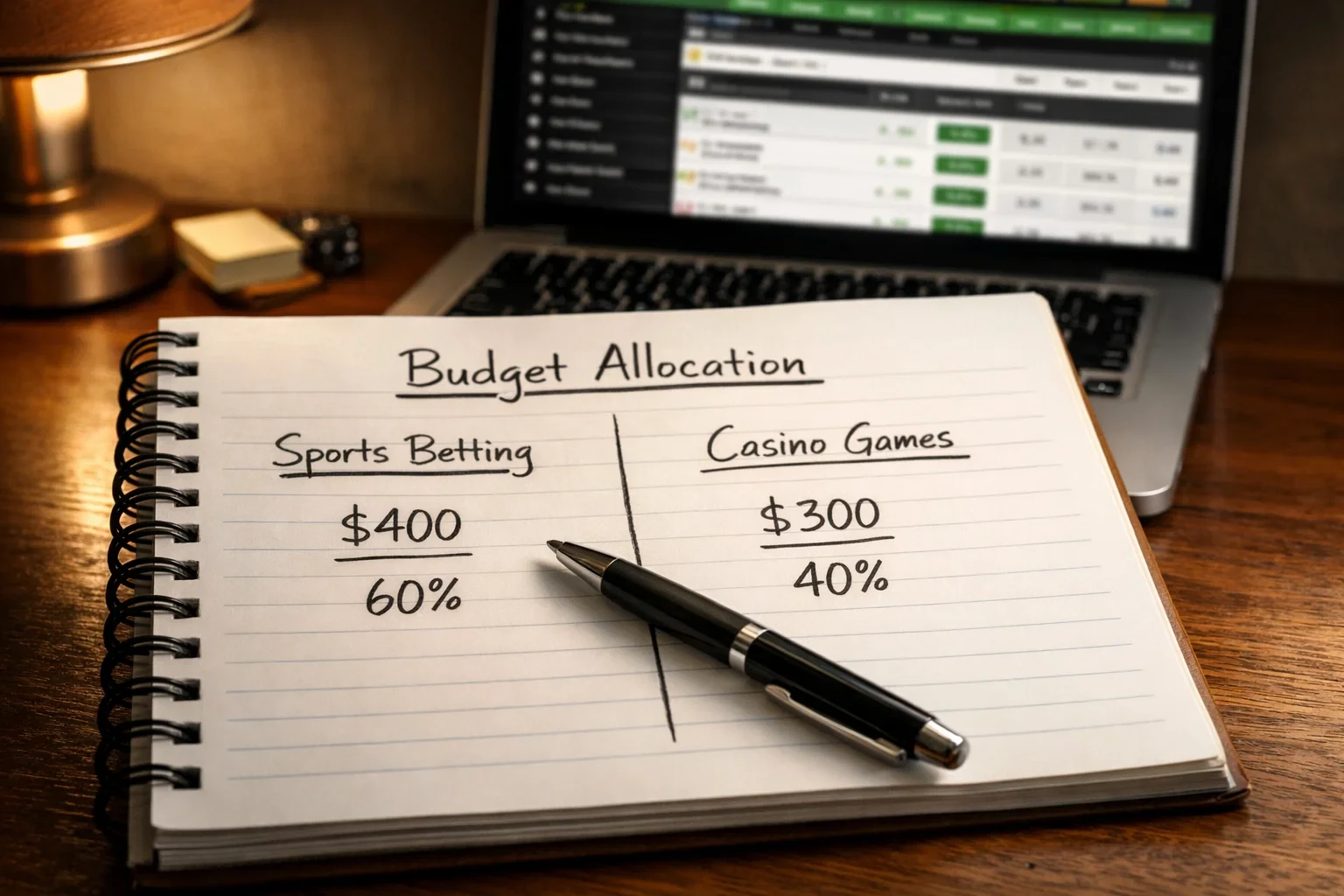
Allocate casino play separately from sports betting bankroll if both activities interest you. This mental and practical separation prevents cross-subsidization where sports betting profits fund casino losses or vice versa. Each activity should be self-sustaining or recognized as entertainment spending.
Use casino bonuses strategically given what you’ve learned about game selection. Bonus wagering requirements clear more efficiently through high-RTP games. A $500 bonus with 15x playthrough requirement demands $7,500 in wagers – placing those wagers on 97% RTP games versus 92% RTP games substantially affects how much of that bonus survives the clearing process.
Practice optimal strategies before real-money play. Blackjack trainers, video poker simulators, and free-play modes let you internalize correct plays without financial stakes. The confident player executing correct strategy automatically performs better than the uncertain player second-guessing decisions under money pressure.
Accept that casino games are entertainment expenses rather than income opportunities. The house always has the edge; optimal play reduces but doesn’t eliminate this reality. Approach casino gaming as you’d approach buying concert tickets – paying for entertainment that has value despite negative expected returns. This framing produces healthier relationships with casino play than profit-seeking orientations that create frustration when mathematical reality asserts itself.
Beat the strict bookie via top casino sports book.
